No Income Insurance: The Risk We Keep Ignoring
We insure our life, health, car, and home — but not the one thing that funds all of them. Income-generating assets are the closest thing to insuring your income.
Key Takeaways
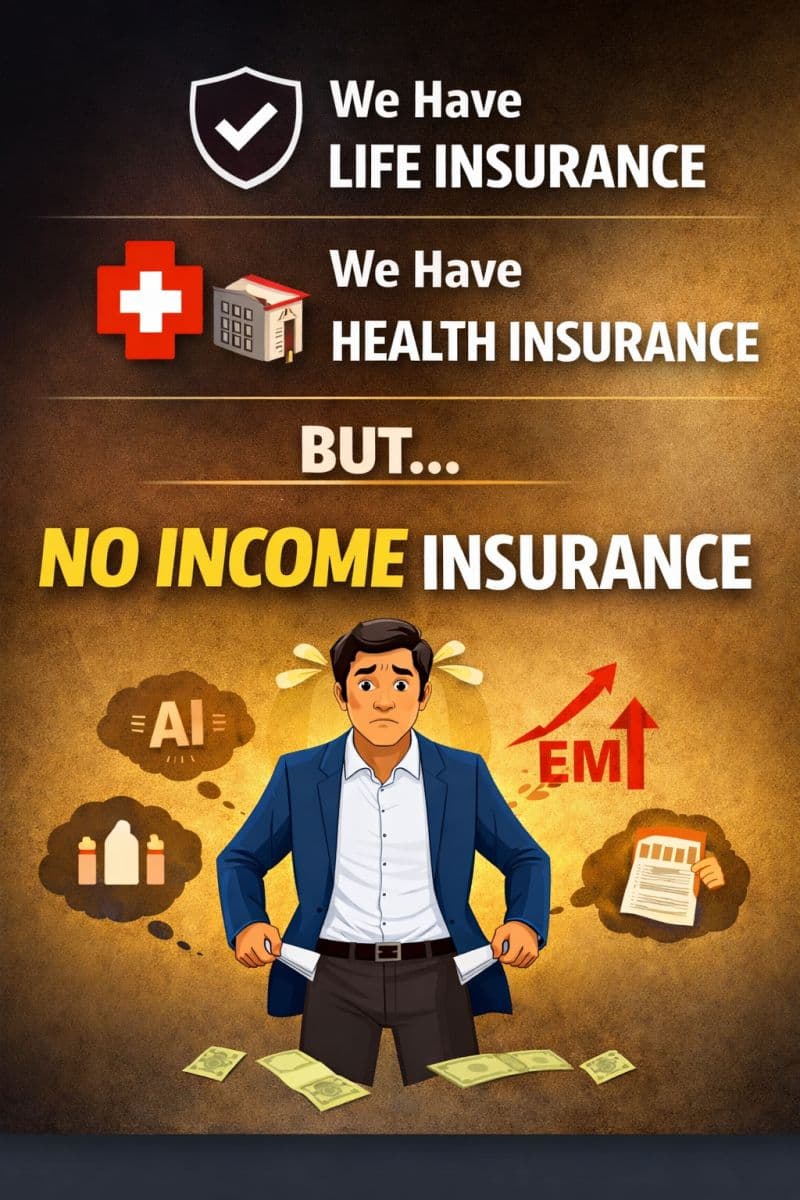
- We diligently insure our life, health, car, and home — yet leave our income, which funds all of them, completely unprotected.
- Most households depend on a single salary at a time when AI, layoffs, and rising EMIs make that dependence riskier than ever.
- Owning a few assets that each pay ₹20–25,000 a month is the closest thing to genuine 'income insurance'.
- Cash-flowing assets do not depend on your boss, your job, or market sentiment — they simply keep paying.
We are remarkably diligent about protecting the things we value. We buy life cover so our family is secure. We pay for health insurance so a medical emergency does not wipe out our savings. We insure the car, and we insure the home. We protect almost everything that matters to us — except the one thing that quietly funds all of it.
| What we protect | Do we insure it? |
|---|---|
| Life | Yes |
| Health | Yes |
| Car | Yes |
| Home | Yes |
| Income | No |
Look at that list honestly. Every protected item is downstream of one thing: your income. It pays the premiums, the EMIs, and the bills. Yet the engine itself — the salary or single business that runs everything — usually has no backup at all.
The Biggest Risk Hiding in Plain Sight
For most households, the entire financial structure rests on one source of income. And that source is under more pressure today than at any point in recent memory:
- AI is disrupting jobs faster than most industries can re-skill for.
- Layoffs have been normalised — even at large, profitable companies, headcount is now a lever pulled without warning.
- EMIs are rising as borrowing costs stay elevated, raising the fixed monthly bar you must clear.
- Lifestyle costs keep creeping up through quiet lifestyle inflation — each raise gets absorbed before it is saved.
A single point of failure carrying that much weight is the biggest risk most of us conveniently choose not to think about. We will spend hours comparing health-insurance plans and never once ask, what happens to us if this one income stops?
What Income Insurance Actually Looks Like
You cannot buy a policy that replaces your salary on demand. But you can build something that behaves remarkably like one. Imagine owning a handful of assets that each generate ₹20–25,000 a month, independent of your job. Even three or four of them can quietly:
- Cover a meaningful slice of your household expenses
- Reduce the financial stress that one bad quarter at work can create
- Give you real breathing room to make decisions from choice, not fear
Why Cash Flow Beats a Lump Sum Here
A large one-time corpus can certainly help, but it solves a different problem. Income insurance is about regularity — money arriving every month to match the bills that arrive every month. That is exactly what a portfolio of managed, income-generating assets is engineered to do: replace fragile, single-source dependence with steady, multi-source cash flow.
That is the closest thing to income insurance there is — and it does not depend on your boss, your job, or market conditions. Just consistent cash flow that shows up whether or not you do.