The Real Game-Changer: Yield vs Cost
Most people ask what a property costs. Smart investors ask what it earns versus what it costs — and that single shift is where the real wealth game begins.
Key Takeaways
- The right question is not 'what is the price?' but 'what does it earn versus what it costs to finance?'
- A typical apartment leaves you funding ₹30–40K a month from your pocket; a yield-focused asset closes that gap to near zero.
- When rental yield sits close to your interest rate, the asset effectively pays its own EMI.
- That is the moment you stop speculating on future value and start building cash flow with leverage.
Most people look at real estate and ask one question above all others: what is the price? It feels like the natural starting point — and it is exactly why so many otherwise smart buyers end up with assets that drain them for years.
The better question, the one experienced investors lead with, is sharper: what does this asset earn versus what it actually costs to finance? Price is a single moment. The relationship between yield and cost is what you live with every month for a decade or more.
A Simple Comparison
Take two properties bought with similar leverage. The headline price might look comparable, but the monthly reality could not be more different.
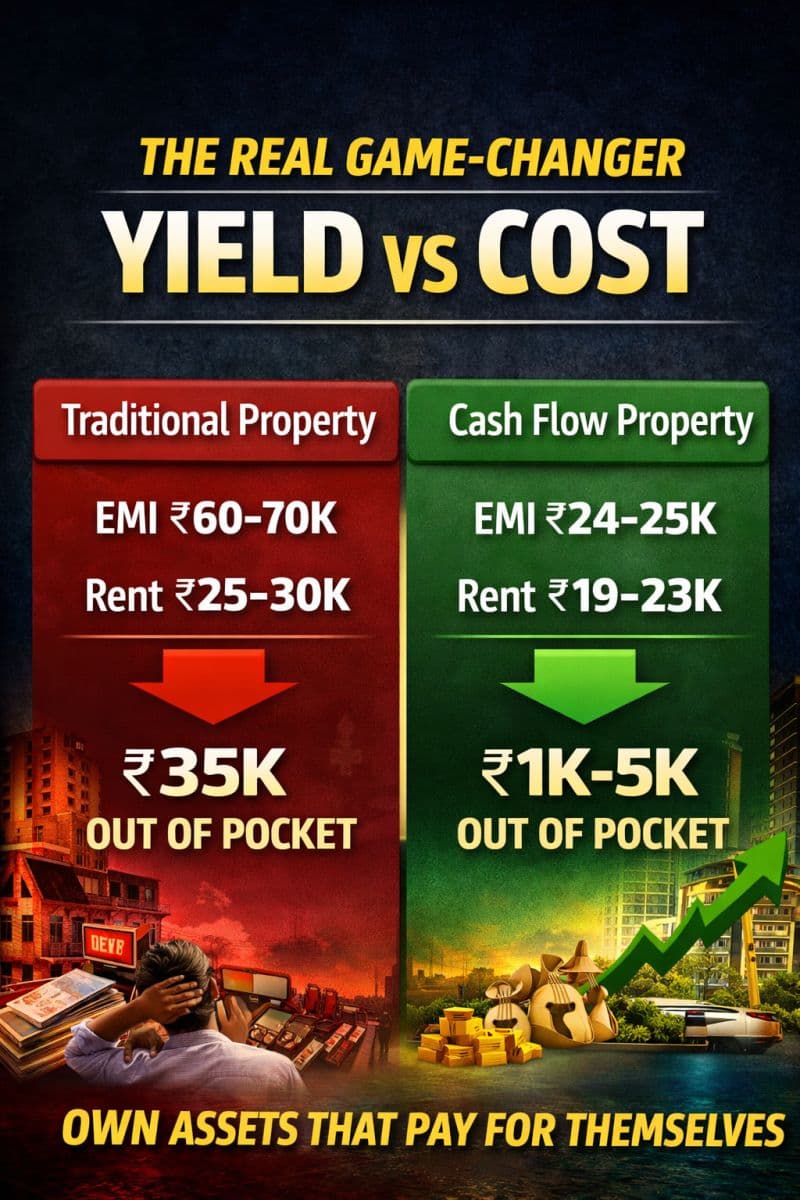
| Monthly cash flow | Typical investment | Yield-focused asset |
|---|---|---|
| EMI | ₹60,000–70,000 | ₹24,000–25,000 |
| Rental income | ₹25,000–30,000 | ₹19,000–23,000 |
| Out of pocket | ₹30,000–40,000 | Almost nil |
Read that bottom row carefully, because it is the whole story. With the typical apartment, you are quietly subsidising your own investment to the tune of ₹30–40,000 every month — for years. With the yield-focused asset, the rent very nearly covers the EMI, and that single difference changes everything:
- The asset pays for itself instead of feeding on your salary.
- Your monthly outflow is minimal, so your lifestyle and savings stay intact.
- Risk reduces significantly — you are not exposed if your income dips, because the property is not relying on it.
Yield Close to Borrowing Cost
Here is the principle the table is really illustrating: chase a yield that sits close to your cost of borrowing. When the rental yield on an asset is roughly equal to the interest rate on the loan financing it, something powerful happens — the tenant, in effect, pays down your EMI for you.
At that point you are no longer simply buying property and hoping. You are building cash flow with leverage: using the bank's money to acquire an asset that services its own debt, while you retain the upside. You no longer need prices to rise for the deal to make sense — appreciation becomes a bonus rather than the entire thesis.
Why This Matters More in a High-Rate World
When borrowing was cheap, a low yield could be forgiven; the gap between rent and EMI was small. With rates elevated, that gap punishes weak-yielding assets brutally — every month. Which is precisely why the yield-versus-cost lens has gone from a nice-to-have to the single most important filter a leveraged investor can apply today.
The bottom line is simple: own an asset that practically pays for itself — and let the yield, not the speculation, do the work.